Transcript
Announcer:
You’re listening to Clinician’s Roundtable on ReachMD, and this episode is supported by an independent grant from Insmed. Insmed had no editorial control over this program, and all views expressed belong to the speakers. And now, here’s your host, Dr. Charles Turck.
Dr. Turck:
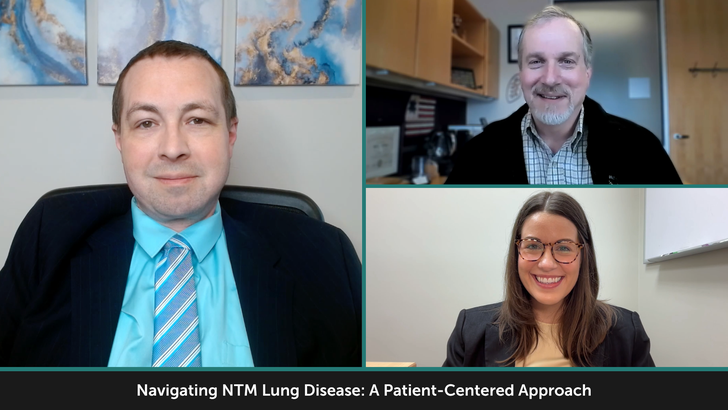
Welcome to Clinician's Roundtable on ReachMD. I'm Dr. Charles Turck, and joining me to discuss patient-centered treatment planning in nontuberculous mycobacterial, or NTM, lung disease are Drs. Kenneth Olivier and Shelby MacRae. Dr. Olivier is the Michael E. Hatcher Distinguished Professor of Medicine, Microbiology, and Immunology at the University of North Carolina School of Medicine, where he also serves as Research Director of the Bronchiectasis and NTM Care and Research Center.
Dr. Olivier, it's great to have you with us today.
Dr. Olivier:
Glad to be here. Thank you.
Dr. Turck:
Also joining us is Dr. Shelby MacRae, who's an Assistant Professor of Pulmonary and Critical Care Medicine and Director of the Environmental Lung Disease, Bronchiectasis, and NTM Program at Louisiana State University Health Sciences Center in New Orleans.
Dr. MacRae, thank you for being here today.
Dr. MacRae:
Thanks for having me.
Dr. Turck:
Well, Dr. Olivier, let's start at the point of diagnosis. In NTM lung disease, how do factors like symptom burden, radiographic progression, microbiologic persistence, and patient risk influence your decision between immediate treatment initiation versus close observation?
Dr. Olivier:
That's a great question that comes up quite frequently. I think one of the things that's confusing is when people get a positive culture back for mycobacteria, the knee-jerk reaction is to initiate treatment. Unlike, say, walking pneumonia, where you hand them a bottle of pills and say "Take this" and you're done—it's a sprint—treatment of these infections is more of a marathon. And I think a lot of thought and preparation needs to go into that. So making sure that you're recovering the same species repeatedly, preferably on sputum specimens, is important. Looking to see if there is significant evidence of radiographic disease, especially if that disease is progressing.
And then I think, very importantly, is how the patient is feeling and what kinds of symptoms they have that might be related to the disease. These drugs are sometimes difficult to tolerate, though in most patients, we can get them to tolerate it. And there may be factors or associated conditions, say rheumatoid arthritis, where there may be drugs that might influence that treatment, or other personal factors of the patient that need to be taken into account when doing shared decision-making and making that choice about when to start treatment.
Dr. Turck:
And if we turn to you now, Dr. MacRae, and focus on disease behavior, how do differences across NTM species influence your overall management strategy?
Dr. MacRae:
The species is hugely important in terms of management. There's over two hundred different species and subspecies of NTM, and the likelihood that they're associated with true NTM pulmonary disease and true clinical infection really depends on which species that we're dealing with. And then when we're looking at the species that are more likely to be reflective of a true infection, which species or even subspecies that you're dealing with impacts treatment decisions and the likelihood that treatment is successful.
So looking at MAC, which is Mycobacterium avium complex, it tends to have a higher likelihood of treatment success versus Mycobacterium abscessus complex. Even when you get down to the subspecies, that can factor into whether that subspecies is going to be susceptible or resistant to macrolides, which impacts how likely we are to sustain culture conversion.
And so when discussing with a patient about whether we are initiating treatment, what treatment we are going to do depends on which species we are dealing with and how we're going to participate in that shared decision-making.
Dr. Turck:
So then once you've made the decision to treat, Dr. MacRae, what principles play a role in regimen selection?
Dr. MacRae:
There are many principles that play a role. I think the number one most important is patient preference and patient priorities. Like Dr. Olivier mentioned, we generally can get people to tolerate treatment, but treatment always involves multiple antibiotics for a prolonged period of time. Sometimes patients will experience adverse effects, and some of those adverse effects are not going to be reversible. And so this really has to be something that the patient is informed about.
In my personal practice, when I can avoid it, I prefer not to start treatment the first time I'm meeting a patient. Like Dr. Olivier mentioned as well, this is a marathon, not a sprint. And so building that rapport, building that trust, and really understanding what's important to the patient factors deeply into my decision of how I'm going to treat.
I generally base my treatment off of the guideline-based recommendations, but there's a lot of variation that depends on the patient's comorbidities. Unfortunately, many patients who are being treated for NTM have been treated for NTM in the past. And so how did they tolerate treatment before? Was there a medication that they did not tolerate? If they didn't, I'm probably not going to restart that medication. Again, what are their comorbidities?
Drug susceptibility testing certainly factors into the decision there, but also knowing how to interpret the drug susceptibility testing. Often you'll get a report with many different antibiotics listed, and some of those MICs are very important in terms of how likely treatment is to be successful, and some aren't necessarily associated with that.
Dr. Turck:
For those just joining us, this is Clinician's Roundtable on ReachMD. I'm Dr. Charles Turck, and I'm speaking with Drs. Kenneth Olivier and Shelby MacRae about treatment decision-making strategies in nontuberculous mycobacterial, or NTM, lung disease.
Now, if we look beyond initial therapy, Dr. Olivier, how do you approach treatment escalation or modification in refractory or treatment-experienced disease, and where do inhaled therapies and other advanced strategies fit in this setting?
Dr. Olivier:
This is where it can get a bit difficult. Assuming that you've gotten the patient started on a regimen that they're able to tolerate and they're actually taking the medication, and the patient may be persistently culture-positive for the organism that you're targeting with treatment, their symptoms may be persisting—particularly things like weight loss are quite concerning, or you may be seeing progression on CT scans or radiographic imaging. Those things all suggest that your treatment is not working.
I think one of the first steps we take is to review what the patient's experience has been like with the treatment to make sure that they are actually taking it, and that they haven't stopped one or more of the medications because of side effects. We find out a little bit about when they're taking their medications and other factors that might contribute to this, such as airway clearance measures and whether they're adhering to those measures, which are an important part of the background treatment in many patients.
If we've assessed all of those factors and it still appears that they're not responding, we then begin to look at treatment augmentation. And this might include additional medications. There is an FDA-approved drug specifically for this purpose for patients that have gone six months into their treatment course and still are not responding to treatment. And the inhaled drug, amikacin liposome inhalation suspension, or ALIS, has been approved as an add-on therapy, for patients who are failing guideline-based therapy for Mycobacterium avium complex.
When we look at using this drug, there are several factors to be considered. It needs to be approved. Sometimes that can take a bit of time. There can be side effects associated with it. Frequently, those are respiratory tract related and may be temporary in nature, but letting the patient know that there may be voice alterations, there could be sore throats.
It's also sometimes may be necessary to alter the dosing frequency. Some people start with less frequent dosing and build that up over time, and we think that that's okay. These aren't acute infections where getting maximal treatment right away is important. It's more important that the patient can tolerate the therapy and be able to remain on it.
So some of those mitigation strategies can be helpful in utilizing that medication. There may be patients such as those with severe hearing impairment, or patients who have significant reactive airways disease, where that particular drug may not be the best option. We then might look at other drugs that have been compared to guidelines-based regimens.
And then finally, depending on the patient's anatomy of disease, if they've got focal involvement, say in the front part of the chest or maybe cavitary involvement, considering whether they may be surgical candidates. Sometimes removing the most significantly involved parts of the lung can allow the medications to then work better to get the disease under control.
Dr. Turck:
And Dr. MacRae, given that treatment often continues for many months after culture conversion, what strategies do you use to monitor microbiologic response and proactively manage adverse events?
Dr. MacRae:
I think the proactive management is key. This is going to involve seeing patients frequently, and so making sure if you're making the decision to start someone on treatment, the clinic is set up to be able to have frequent visits and an ability for patients to get in touch in between visits because adverse events are common.
I think setting the expectation for monitoring sputum cultures is very important because that's going to determine how long our treatment course is. Once in a while, when we start treating the NTM, patients really stop being able to produce sputum as the treatment takes effect, even with using airway clearance therapy, et cetera. There may need to be some counseling in that situation. And sometimes, in that situation, we do have to perform a bronchoscopy at some point later in treatment. I also like to co-test for regular sputum cultures as well as the AFB cultures because that helps me determine, number one, what was the quality of that sample? Was it just saliva or was it actually a lower respiratory tract sample? And it also can help us see if there's other microorganisms that may be playing in here—something like Pseudomonas or Haemophilus influenzae that may be worsening their symptoms but is unrelated to their NTM.
In terms of monitoring, I think education upfront with the patient is really important so that they know which adverse effects to be on the lookout for. There's many different factors here that need to be explained to the patient, and really, I think the onus is on us as the providers to have the, the structure to help guide them through this. You really can't start someone on treatment and then say, "See you in six months. Good luck." That’s not going to work because we frequently have to monitor these things and modify our regimen.
And I also just would like to say that sometimes we have to stop treatment. Sometimes the toxicity gets really severe, and I think having that conversation with the patient—again, just to emphasize how important the rapport is there because unfortunately sometimes we do have to stop—being able to have that conversation with the patient and decide what's best in that shared decision-making situation is so important. And for the patient not to feel guilt or not to feel like they're doing anything wrong—this is tough treatment, and we need to be a team in it.
Dr. Turck:
Now, before we close, Dr. Olivier, let's look at the big picture here. NTM treatment can place a substantial physical and emotional burden on patients. So how do you incorporate shared decision-making and multidisciplinary care to support adherence and long-term patient outcomes?
Dr. Olivier:
It really takes a team, and I think that team needs to include the patient's primary care provider. It needs to include the referring providers. And having the whole team involved in the areas that impact treatment is very important, and also to have everyone on the same page to encourage the patient as they go along.
It's very difficult to throw all of this at a patient the initial time that you're meeting them. And so knowing how to slowly introduce this—we have the good fortune of having a clinical pharmacist practitioner in our clinic. And so at the initial visit when we're actually in starting treatment, there are multiple people who are interacting with the patient. We have a nurse coordinator, who is sort of our chief of communication. We have respiratory therapists involved in our clinic, who can help with the various machinery involved if they're on inhaled medications and the nebulizers—making sure those are working appropriately.
And finally, it's really important to recognize the social situation that the patients come from. Involving social work and, if your team has access to them, clinical psychologists can be helpful. There have been studies that have shown that there can be an increased association with both anxiety and depression associated with this diagnosis and its treatment. And making sure that those aspects of the overall health are managed properly is important as well.
Dr. Turck:
Great strategies for us to think about as we come to the end of today's program. And I want to thank my guests, Drs. Kenneth Olivier and Shelby MacRae, for joining me to discuss patient-centered approaches to treatment decision-making in nontuberculous mycobacterial lung disease.
Dr. Olivier, Dr. MacRae, it was great having you both on the program.
Dr. Olivier:
Thank you. Enjoyed it.
Dr. MacRae:
Thank you.
Announcer:
This episode of Clinician’s Roundtable was supported by an independent grant from Insmed. Insmed had no editorial control over this program, and all views expressed belong to the speakers. To access this and other episodes in our series, visit Clinician’s Roundtable on ReachMD.com, where you can Be Part of the Knowledge. Thanks for listening!